
A generation which ignores history has no past and no future
Robert Heinlein (american writer)
General Information
Disclaimer: The umbrella-term ‘Roma’ encompasses diverse groups, including Roma, Sinti, Kale, Romanichels, Boyash/Rudari, Ashkali, Egyptians, Yenish, Dom, Lom, Rom and Abdal, as well as Traveller populations (gens du voyage, Gypsies, Camminanti, etc.). EU policy documents and discussions commonly employ this terminology.
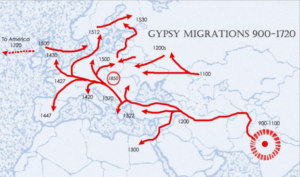
The Roma (Gypsies) are an ethnic group that arrived in Europe from India in the 14th century. The fact of how they left India is still argued, however it is generally accepted that they did emigrate from northern India sometime between 6th and 11th century. The Romani people are widely known in English by the exonym Gypsies (or Gipsies),which is considered by many Romani people to be pejorative due to its connotations of illegality and irregularity as well as its historical use as a racial slur, therefore the word ‘Gypsy’ should not be used in any context.
The word ‘Gypsy’ is an abbreviation of ‘Egyptian’ , because it was believed that they came from Egypt. The German word ‘Zigeuner’ and the Slav word ‘tsigan’ or ‘cigan’ have a different source. They come from the Greek word athiganos meaning heaten.
Early History
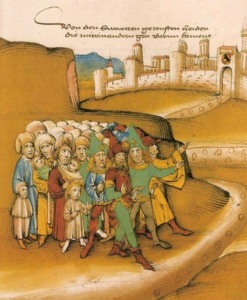

The first Roma migration into Europe happened during the 14th and 15th century, and the Roma were farm-workers, blacksmiths and mercenary soldiers and also musicians, fortune-tellers and entertainers. In the beginning they were welcomed, because of their diversion of the dull everyday life of that period.
Soon, however, they attracted the antagonism of the 3 powers of that time:
- the state
- the church
- the guilds
The civil authorities wanted everyone to settle legally at a permanent address and pay taxes. The church was against the heresy of the fortune-telling, while the guilds were against the price cuts that the Roma introduced (Roma worked from the tents and they were trading, which undercut the prices from the locals). Another factor was that the Roma were dark-skinned, which was negative feature of that time in Europe.
After this mistrust and antagonism towards Roma, it was inevitable to get a reaction from authorities. In 1482, the Holy Roman Empire passed laws to banish all Romani from its territory, and the punishment was often death. There was some migrations, however the policy of expulsion failed in most cases, as the countries to which they were deported often returned them quietly over the borders.
The regions that managed to clear all visible trace of Romani were the Scandinavian countries and the Netherlands. Therefore, governments decided to change the policy to enforced integration and assimilation.
The latter part of the 19th century saw a new migration westward as Romania released its Roma ( they were slave there). Many thousands emigrated as far as America, Australia and South Africa.In the 19th and 20th century in western Europe, Roma had problems finding stopping places, as camping on the side of the main roads, because of the UK Highway Act of 1835. Consequently, settlements were built on wastelands but also authorities stepped in and evicted the families.
The Holocaust
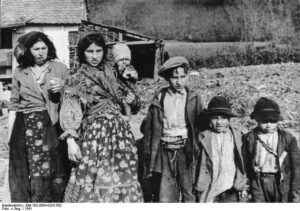
The Nazis regarded Roma as a race and made them subject to the Nuremberg Laws of 1935.
These laws forbade ‘mixing’ Aryan(German race) and other races, in order to keep the ‘purity’ of the Aryan race. During the Nazi regime, Roma were not allowed to practice music as a profession and Roma children were banned to from school. Camps were set up for nomads on the edge of the towns. Even the Roma who were not nomads in that time were forced to reside in the camps.
- In 1939 it was decided to send 30,000 Roma from Germany and Austria to Poland, however the deportations were stopped due to shortage of transport.
- In 1942 Himmler(head of SS) signed the so-called ‘Aushwitch decree’ and in the following year 10,000 German Roma were sent to Auschwitz concentration camp. Moreover, sterilization campaign was undertaken in and out of the camps and also the labor of Roma was needed in the factories where the V1 and V2 rockets were made. The slaves however, were not permitted to reproduce.
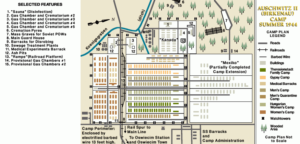
Medical researchers assigned to the Auschwitz complex, such as SS Captain Dr. Josef Mengele, received authorization to choose human subjects for pseudoscientific medical experiments from among the prisoners. Mengele chose twins and dwarves, some of them from the Roma family camp, as subjects of his experiments. Approximately 3,500 adult and adolescent Roma were prisoners in other German concentration camps; medical researchers selected subjects from among the Roma incarcerated in Ravensbrück, Natzweiler-Struthof, and Sachsenhausen concentration camps for their experiments, either on site in the camps or at nearby institutes.[https://encyclopedia.ushmm.org/content/en/article/genocide-of-european-roma-gypsies-1939-1945]
The SS leaders chose not to confront the Roma directly and withdrew. After transferring as many as 3,000 Roma to Auschwitz I and other concentration camps in Germany by mid-summer of 1944, the SS moved against the inmates on August 2 and killed 4,300 Roma. Most of the victims were ill, elderly men, women, and children. The camp staff killed virtually all in the gas chambers of Birkenau. A handful of children who had hidden during the operation were captured and killed in the following days. Approximately 21,000 of the 23,000 Roma and Sinti sent to Auschwitz died there.[https://encyclopedia.ushmm.org/content/en/article/genocide-of-european-roma-gypsies-1939-1945]
It is not known precisely how many Roma were killed in the Holocaust. While exact figures cannot be ascertained, historians estimate that the Germans and their allies killed between 250,000 and 500,000 European Roma View This Term in the Glossary during World War II. It is estimated that the prewar Romani population numbered between 1 and 1.5 million.[same]
After 1945
In the first years after WW2, the roma community was in disarray. The family structure was broken with the death of the older people, the guardians of the tradition. Roma ‘solved’ the psychology problems presented by not speaking about the time in camps. Only handful number of Roma could read or write, so it was very difficult to tell their own story. In the many historical books about the Holocaust, Jews were mainly discussed and Roma usually appear as a footnote or appendix.
A small group of survivors in Munich began collecting evidence of the Roma genocide, however after 20 years of the event. No global reparations were made and not many individuals received restitution. Eventually those Roma who held German citizenship received compensation for their suffering.
After 1945 in eastern and western Europe, a return of nomadism was discouraged and living by the roads was illegal and dangerous, due to increasing motor traffic. Roma were seen as a social problem to be integrated to the wider community. Pressure from the central governments to set up camp sites was largely ignored by the local authorities.
In most countries in eastern Europe the Roma population was very large and policies evolved to meet the challenge of this large unassimilated minority. In the case of Soviet Union, Stalin had decided that the Roma had no land base and therefore could not be a nation. Assimilated Roma were encouraged to change their ‘nationality’ in their passports to the one in the majority and answer the census question as Serbs or Russians.
It was in the west that the foundation of an international Roma organization could be formed. The real beginning was the committee know ans Comite Ineternational Tzigane set in Paris by Vanko Rouda. This body organized the first World Romany Congress. This body organized more congresses, and the fourth Congress in Warsaw in 1990 was attended by delegations from Romania and the Soviet Union.
In order to commemorate this horrendous event, there is the Roma Holocaust Memorial Day, and the date is chosen to be 2 August the day when almost 3000 Roma died in Auschwitz.
More resources related to Roma history:
- Alliance against Antigypsyism
- Council of Europe Factsheets on Roma History
- US Holocaust Memorial (Roma in pre-war Europe)