As the European Union strengthens its legal framework to tackle illegal hate speech online, new evidence suggests that antigypsyism remains deeply embedded in Europe’s digital spaces.
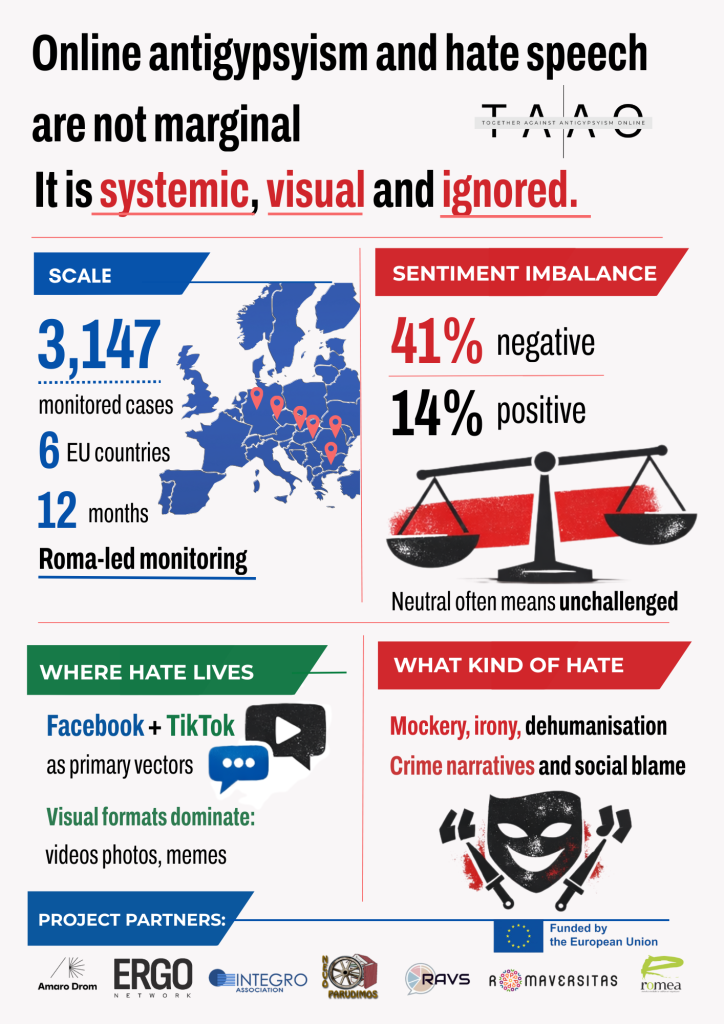
The Together Against Antigypsyism Online (TAAO) project has released a sneak peek of its upcoming EU synthesis report, drawing on Roma-youth led monitoring carried out across Romania, Bulgaria, Czechia, Slovakia, Germany, and Hungary.
While monitoring activities focused on five countries, Belgium contributed primarily through advocacy work within the project.
The early findings are stark. Over a 12-month period, 3,147 cases of online antigypsyism and hate speech were documented, largely across Facebook and TikTok, where visual formats such as videos, images, and memes dominate. Far from being marginal or isolated, antigypsyist content appears systemic, visual, and frequently unchallenged.
According to the sneak peek data, 41% of monitored content carried a clearly negative sentiment, while only 14% was positive. Much of what is labelled as “neutral” often goes unchallenged, effectively allowing harmful narratives to circulate unchecked.
Mockery, dehumanisation, and crime-related stereotypes emerged as recurring patterns, reinforcing long-standing social blame directed at Roma communities.
TAAO report infographic
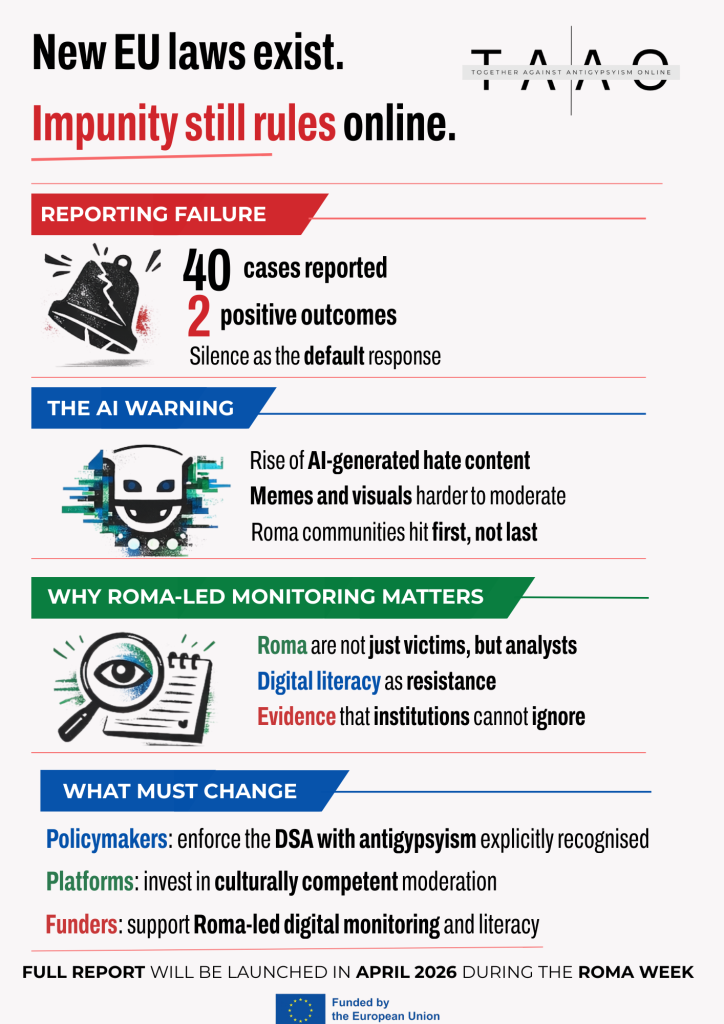
The findings also raise concerns about reporting and accountability. Of the thousands of cases monitored, only 40 were formally reported, resulting in just 2 positive outcomes. Silence, rather than redress, remains the default response. This gap persists despite the introduction of new EU rules under the Digital Services Act (DSA), indicating significant challenges in enforcement and platform responsiveness.
The sneak peek also flags an emerging risk: the rise of AI-generated hate content, particularly in visual formats that are harder to detect and moderate. As previous experience shows, Roma communities are often among the first affected, rather than the last.
At the core of TAAO’s approach is Roma-youth led monitoring. Roma are not positioned solely as victims of online hate, but as analysts, monitors, and contributors to evidence-based policy discussions. Digital literacy and community monitoring are treated as tools of resistance and accountability, producing data that institutions can no longer ignore.
The full EU synthesis report will be officially launched in April 2026 during Roma Week, bringing together national findings, policy analysis, and concrete recommendations.
These will focus on the need for explicit recognition of antigypsyism within DSA enforcement, culturally competent content moderation, and sustained support for Roma-led digital monitoring and literacy initiatives.
While not exhaustive, the findings provide an early indication of how antigypsyist narratives continue to circulate online, often with limited challenge or response. The question now is whether Europe’s legal and political tools will be used with the urgency the evidence demands.
Keep yourself updated about the TAAO project on our website